
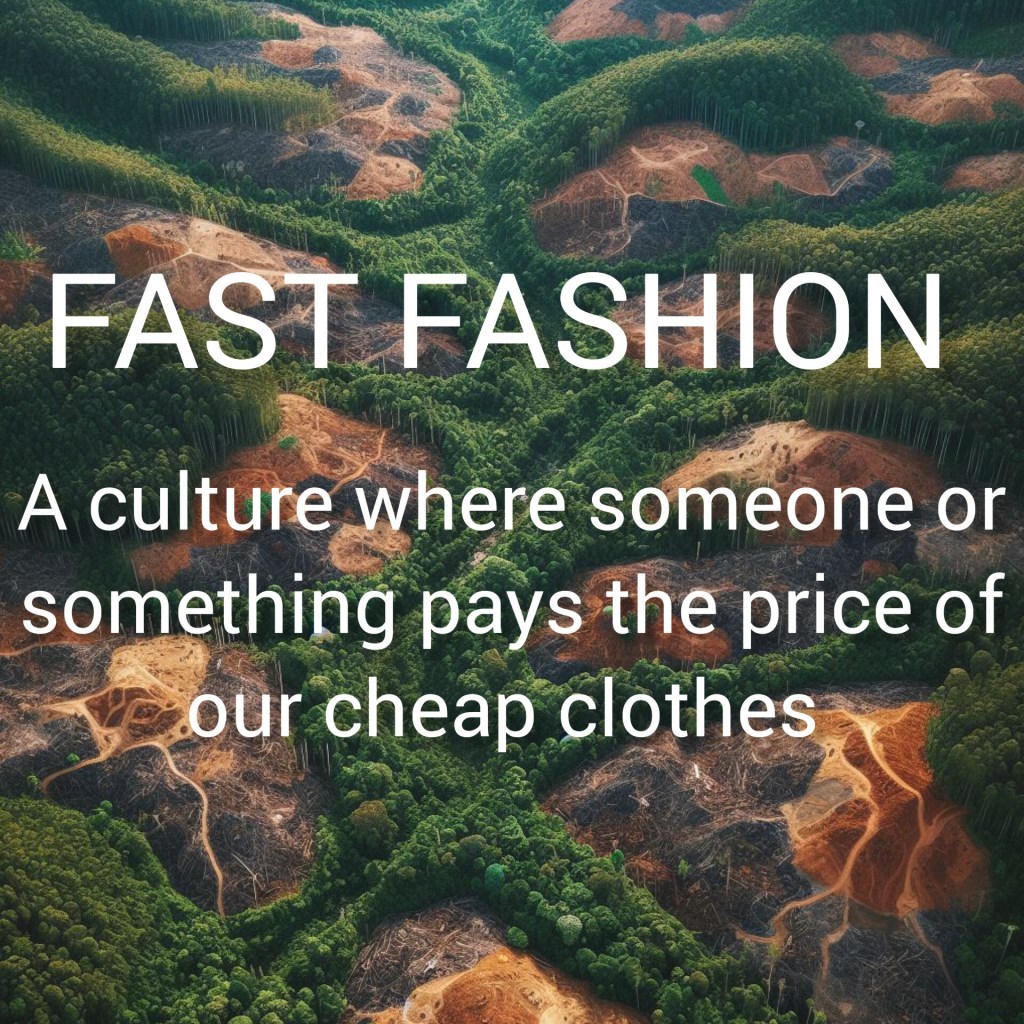
FAST FASHION
Fashion denotes the latest or the popular style. It gives a space for creative-expression and self-expression. Over the years, trends have become part of cultures. Changing fashion helps to keeps life vibrant and adds colour to the day that keeps repeating. But the problem comes when ‘fast’ gets added to fashion.
Fast fashion, mass production of latest designs and trends and selling it to the consumers at a cheap price. Something that I too am guilty of. I have been struggling to and some part of me is still struggling to overcome it. I walk into a clothing store to buy something necessary or to replace something, my eyes are stuck on the sign- Clothes starting at just Rs.199 ($2.40), And the mind goes ‘Wow just 199, let me check.’ In the isle I am greeted by latest designs, again mind goes, ‘ Oh wasn’t that model wearing this? Oh isn’t this in trend right now? What if I don’t get such a great deal again?’ I end up leaving the store with a pile of clothes that neither was I planning to buy nor I need.
The story seems harmless. Me spending money on things that makes me happy. But the problem is invisible or we don’t care to notice. Overconsumption is fine till we care to check for ‘behind the scenes.’

It is not just, my money-my choices, every decision of ours has a far reaching impact, especially when Earth is at a such crucial point- Every decision that we take has environmental and humanitarian consequences. It is time that we stop waiting for leaders and organizations to act and lead us, the real power to bring change lies with the mass, with the ordinary people like you and me. It is our choices that lead the ‘leaders’ to act, that is the sad truth.
With fast fashion we are happy as consumers, or are we? In reality we are missing the truth. Exploitation of natural and human resources, price paid for the fast changing cheap styles and trends.
ENVIRONMENTAL CONSEQUENCES
It is well known that 2,700 liters of water is required to produce one t-shirt and 7,600 liters of water for a pair of jeans. If we assume that 3 liters is the average amount of water an individual drinks per day, then that is 900 days and 2533 days of drinking water (for an individual).
Further more, the chemicals and dyes used in the clothing industry gets washed into land and water, thus polluting them. Extent of pollution is increased with the need to transport raw materials and finished products from place to place.
Moreover, nowadays most of the clothes are made of synthetic materials like polyester. Polyester is a petroleum derivative, that means more fossil fuels. Although so-called environment friendly polyesters, which are derived from recycled plastic and waste materials, exists, they have their own consequences. First being, when polyester clothes are washed they shed fibers, these are non-biodegradable and reach water bodies, adding to the micro plastic pollution in these reservoirs. Also, once the clothes are no longer needed, they are thrown away and reach landfills. Being non-biodegradable, these remain intact, polluting the landfills and as they shred, the fibers cause more micro-plastic pollution. Production of polyester , when compared to other materials used to make clothes, is energy intensive, that is making of polyester requires more energy when compared to other materials like linen, cotton etc.
Fashion industry, produces around 10 percent of annual global carbon emissions and it is estimated that by 2030, this will be 50 percent or more. To add to this, fashion industry is the second largest polluting industry in the world. Things don’t end here,
HUMANITARIAN CONSEQUENCES
Have you ever wondered how the fast fashion companies are able to sell clothes at such a low price? It is quite clear that with the cost of energy and the amount of work and materials being used in making each piece of cloth, it is not possible to make profit by selling a t-shirt at Rs.199($2.40). But no major clothing company is in loss, in fact it is one of the most successful and fast growing line of business. How? Yes, the cheap clothes comes at a cost- one that is paid by poverty, child labour and inhumane conditions.
Farmers are paid meagre amount for the raw materials. While companies are making profits in the range of millions, farmers and labourers work hard to meet the ends. Then most affected are those working in the factories- stitching, sorting, packing. Most of the times, they are paid below minimum wages, pushing them into a vicious cycle of poverty. Also, they do not have any job security, no rights and many at times have to work for long hours in cruel conditions.
Most companies don’t pay decent wage to the staffs and those working in the outlets. They have no voice as they can be easily replaced. And for the profits, many companies attain the materials from places that are least concerned about environment and the dying earth.
The question of the hour is what can be done? Throw eggs, throw soups, burn down places and buildings, carry out violent protests, block roads? No. Or sit back saying that, what can I do? I don’t have the power, I cannot change or influence the company heads.. Both won’t work- first one will get us no where and the second one is not true, the real power to create change is within us. We decide what goes in and out of the society.
WHAT CAN BE DONE?

Our choices as an individual and collective matter. But keep in mind that we are living in a post modern world, here money matters, so any alternative we choose will have its effects; but the thing is to pick up an alternative that causes least harm and is based on values that we believe in. Thus slowly build a society that is sustainable and close to our roots embedded in nature.
What I meant is, We can choose cotton instead of polyester or other synthetic fibers. But, cotton farming uses a large amount of pesticides, it is said that cotton uses 16 percent of the total insecticides used world wide and requires a huge amount of chemical fertilizers.
So the idea is not to completely banish one and pick up the other, but take steps that can ensure a more sustainable existence. But the goal must be to use technology and traditional methods to develop ways, here fibers, that are eco-friendly. Some of the things we can do are;
- Think 20 times before you make any purchase. By any I mean any… Our planet is at a pivotal place, resources matter and no more waste can be tolerated. So make sure that you really need something before buying it. Think as if your whole existence depends on that one decision (because it does). Over consumption is the main evil of our time.
- Buy quality products– Check the clothing item before buying it. Make sure that it will last you a good while, so that waste can be reduced. It is a sort of investment, a better use of money, if you buy a dress for Rs.1000 ($12.05) and it lasts for 4 to 5 years than buying two dresses for the same price Rs.1000 ($12.05) and lasting for only 2 months. I have clothes that I have been using for 7+ years (still looking new) and clothes that lasted for two washes. So quality matters in reducing waste.
- Promote brands that are ‘truly’ rooted in sustainability and eradicating inequality– Most of the companies portray themselves as humanitarian and environmentally concerned, so that people support them. But actually they are fooling us, the factories and sources shown in the pictures and data are green, environment-friendly and humanitarian. They picture themselves, as based on sustainable development goals, but behind the facade they may be outsourcing production and procurement, this way they can acquire raw materials at a cheap rate and keep labour costs low. So make sure that brands that you choose to promote are legit and rooted to their cause and values.
- Upcycling– The best thing you can do. Upcycling helps to reduce the waste being dumped annually, it keeps us creative and is a fun way to save the planet, an inexpensive way to save the planet. Got an old jeans turn it into a tote bag, got some plastic bottles make a planter. Turn the clothes that you no longer use or are too old onto something else that is useful, like a cushion or pillowcase.
- Give away– Rather that throwing away the clothes that no longer fits you or your style, give them to someone who needs it and can use it. Thus reduce the waste.
- Experiment with the clothes that you already own– rather than running to the store every time you feel like there is nothing to wear, try making new combos and matches out of the existing clothes. We will be amazed to see, how many ways we can style that T-shirt that has been tucked away at the back of our closet for the last 3 years.
- Don’t buy to follow the trends– Every trend is not for everyone. We are unique individuals with unique interests. Don’t buy something because it is all over your social media and everyone you know is buying it or is talking about it. Discover your unique style, buy things that you find appealing, experiment around your interests and discover new styles that you are happy about.
- Remember that every event doesn’t need a new outfit– the point here is, it is normal to repeat outfits, claiming that I don’t wear the same dress twice is not a status symbol.
- Keep your decisions as green and organic as possible
The switch is not easy, I do many things out of habit and have to constantly remind myself. It is more difficult when everyone around you is a certain way and you try to differ, it is hard even when you are doing the right thing. But, stay firm in your beliefs, each step you take matters and there is no time to lose. We never know, maybe we can influence at least one person who is watching our choices. Be loud, let your voice and ideas be heard…
BE THE CHANGE
 Orenda
Leave a comment